zondag 21 november 2010

Green products : A new status symbol?


Green cars, domestic products and fair trade food are bought as status symbol according to a new study, published in the Journal of Personality and Social Psychology. People are willing to sacrifice performance to raise their environmental status by buying hybrid cars. Consumers can even kill two birds with one stone : Because many green products cost more than traditional equivalents, consumers are able to display their wealth while communicating altruism.
Driving non-green cars can communicate status, but it can also suggest the customer is a selfish and uncaring person. In a study one group (A) was told a story about social status while an other group (B) read a story without a status message. Afterwards, they asked to group members to make a choice between a luxurious and better-performing car and a green car. 37% of Group B chose a green car, while more than 50 percent of group A chose a green car. The author claims that playing on desire for social status is a way to encourage consumers to chose green products.


I personally love the fact that people contribute to buying greener products. But of course, as for all of us, I’m still keen on traditional luxury products. I definitely won’t leave out all the luxury, status related goods to become a fanatic green consumer. Am I a selfish person? No I don’t think so, even if I say it myself. Life isn’t about strictly buying environmentally-friendly goods, it’s about becoming aware of the fact that the environment conscious consumers and contributing yourself in a certain degree.
I do believe there’s a market for green products within the luxury industry. Every social class has conscious people. Especially rich people are looking for new ways to express their wealth by doing something morally good.

Luxurious lifestyle manual


How come wealthy people often share a similar consummation pattern, well it seems to be that there is a manual how to life your life filled with luxury. Of course in real life this is not the only reason or even a reason at all.


One of the actual reasons is that people in a social class always look at the social level just above them and see how to consume their extra funds if they would reach that level. Things like this site contribute to this phenomenon as it indicates where luxurious meetings are held, new trends in the luxury network and much more so that a person can try to distinguish himself in the right social level. Not only sites give you these possibilities, magazines and meetings provide a similar service, also it is not exclusive for the luxury sector.


The site also gives you a look at different fashion styles you can try and obtain, like the celebrity style in which the site gives you different looks who were spotted and approved at the red carpet. But this is just the start of the capacities of the site, after a very wide selection range going from food to airplanes you can also decide to order it. So after looking into all of these possibilities you don’t have much more trouble in fixing your purchase as it is just a mouse click away from being delivered to your doorstep, obviously depending on what you just bought.

http://www.justluxe.com/

zaterdag 20 november 2010

Fictitious conspicuous consumption

It might be to expensive for people to buy a genuine Rolex or they might find it not worth the money. Solution for this problem, replica products, is indicated at the following site. When you open the site you immediately see an article describing the benefits of replica watches and other products.


They start by giving an alternative description of conspicuous consumption, these replicas contribute to your appearances and give your self-confidence a boost by upgrading your image. Genuine Rolex watches do this undoubtedly even better but there is a significant difference in the price range. Therefore replicas make a very good alternative if your options are limited. Replicas are sometimes very hard to spot, the site gives the example of Switch Rolex replicas who look very much alike and only an expert might recognize the difference.


My opinion on replicas is ambiguous, I see the benefits because replicas bring a suiting alternative to people with less possibilities with their budget. On the other hand these brands steal ideas from successful genuine products in order to profit from these ideas. Also the brands who distribute cheaper, but original, watches will lose a certain piece of their target audience to these replica brands.

http://www.replicahorloges.info/rolex-goed-idee.html

vrijdag 19 november 2010

a watch, a man's best friend


Who thought that men didn’t care for quality and classy accessories are wrong. Apart from a wedding ring, a watch is the only socially accepted jewel for men. So it’s not surprisingly that men are very choosy when buying one. It has to be one from a brand with a history, one with a high standard quality, one with its own personality, one that is a unique piece of art. Furthermore multiple men even have a emotional relationship with their watch.
It is said that these watch loving men are part of some kind of secret society and that they are able to recognize each other by one simple look at the wrist. Consequentially you can say that luxury watch wearing men have a (strong) bonding with each other and that when they (accidentally) meet they could talk for hours about their precious accessory. And it’s not only the appearance that makes a watch so special, it is above all the technique of the watch, created by Da Vinci, Galilei and Huygens, that makes it so interesting for men. According to these men, it is the complexity and the hours and hours of handiwork that makes it worth the money and gives the watch his own soul.
Luxury brands, like Universal Genève, are aware of these facts and try to stay as traditional and unique as possible.

http://www.standaard.be/artikel/detail.aspx?artikelid=GP831J4TU&word=mannen+horloges

I receive business partners on my yacht

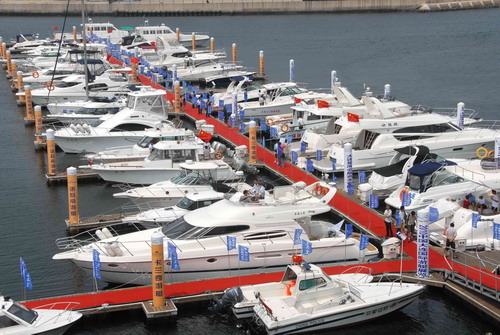
Many people think CEOs of big companies buying impressive yachts are doing this only to stress their status and huge pay, but there are some other reasons why (in this case, Chinese) directors are considering buying a yacht. How do you convince very important clients that your company wants to make the difference? Of course, you have to be able to present a good deal, but there is more. One possibility is to receive your important business partners in a luxury environment. Boring offices and fully booked restaurants are simply not that alluring, not to mention it's completely unoriginal. It's as simple as that: not all CEOs really want to boast about their position, but are forced to luxury products when they want to complete their task successfully.

http://www.chinadaily.com.cn/bizchina/2010-07/22/content_11035745.htm

This article proves that conspicuous consumption is sometimes overestimated. Many people don't really choose conscious for buying luxury products, but are sometimes forced to do that. Especially in China this trend is universal, because big Chinese cities don't lend to make deals in a quiet and relaxing atmosphere.

Fine water


A climate change and an overpopulation in many cities in de world have resulted in the fact that water is becoming more and more scarce and more and more expensive. This current problem has leaded to the creation of a whole new market: Luxury Water. This ‘new’ and non-alcoholic beverage for the wealthy individual has become the new champagne in the more exclusive bars, restaurants and hotels, some of them even have their own water list like a wine list. People are willing to pay almost 30 times more for it because of its unique look ( some bottles look like wine bottles, some are adorned with classy Swarovski crystals and some water bottles are even a piece of art) and because they believe that this water is more healthy than normal mineral water ( it’s coming from certain wells, springs, aquifers and catch basins throughout the world).

I really think that this ‘luxury water’ is a bit overhyped. People who buy this kind of water must have no idea what to do with their money. Why showing of with a bottle of 60$ when it’s almost free from the tap.

http://www.finewaters.com/
http://www.fineh2o.com/

donderdag 18 november 2010

From Patricians to Proletarians

A recent study by Marshall School of Business found that luxury brands charge more for “quieter” items with subtle logo placement and discreet appeal. By examining designer handbags, high-end vehicles and men’s shoes, they were able to identify luxury-good consumer species :
1) Patricians: They are wealthy consumers, low in need for status. They pay a premium for quiet goods, products that only their fellow patricians can recognize.
2) Parvenus: They’re wealthy consumers, high in need for status. They use loud luxury goods to signal to the less affluent that they are not one of them.
3) Poseurs : The people who lack the financial means to buy luxury goods, but they are highly motivated to buy counterfeit items to “emulate those who they recognize to be wealthy.
4) Proletarians : There are the ones with no drive for status consumption.
An other conclusions is that counterfeiters focus on the lower-priced, louder goods. These goods are sold to non-patricians.
http://designtaxi.com/news/32602/Study-Luxury-Brands-Charge-Less-for-Loud-Items-with-Big-Logos/

I chose this article because it really connects to my previous article about snobs and followers. This study classifies the luxury-good consumer in a different way, but we can still recognize the same pattern. We can describe patricians as snobs. We can classify parvenus in a larger extend as followers. You can also count poseurs in a limited degree to the followers, because they try to accomplish status. But I refuse to do that because they mostly buy fake goods. Proletarians do not have a drive to separate them from the followers or to follow, so there’s no criteria to decide to which group they belong.

International TV promoting conspicuous consumption


MTV’s cribs is a popular international television show in which celebrities give the viewers a tour in their mansion. These house owners built their houses up to a certain standard which corresponds with the social status they acquired. I remember a celebrity explaining why he bought an expensive fridge that he hardly uses, the reason for this is that he had heard how many of his friends and neighbors use it. Did he feel obliged to buy a fridge fitting his status?


This television show is just one of many ways in which we get attracted to conspicuous consumption . This phenomenon has grew more accustom in our society and is also reaching people at younger ages. This brings me to my second television show: My Sweet 16. In which 15 year olds get their going on 16 birthday party and get pampered as much as possible, by receiving the car they wanted and an artist to perform at their party.

One thing I have noticed is that on cribs we only get to see pop stars or sport talents. I have yet to see the first judge or CEO’s house on cribs. One most likely reason is that for this shows’ target crowd it would be less appealing, thereby emphasizing that conspicuous consumption is something of all ages. And also something which attracts a big audience, who wouldn’t want to be able to buy a house like that.

woensdag 17 november 2010

My_____: new logo, new website, new reputation

The social network site MySpace has changed its company's strategy: a new website and a new logo have to transform the platform to a more entertaining, exclusive and cool network that will attract more members. During the last years, MySpace (or do we have to write My_____ now?) has fallen on hard times: a good indicator to clarify the company's weak policy. Now this policy has changed: MySpace will not longer compete with other social networks (e.g. Facebook), but will become a "social entertainment destination for Gen Y." To make this vision actual, a new website has been launched and the focus will be on promoting bands and celebrities on video- and audio-heavy pages. MySpace will no longer be a place to connect with your friends directly, rather be a network where you can share interests, share tastes and knowledge around particular topics, and scout out up-and-coming subcultures.

MySpace has realised that their old policy (where in they tried to compete with other social network websites) was not the right way to do business. A new image (by means of a new and attractive website, a new logo and a new concept) has to upgrade the company's whole reputation. Hopefully, this new way of working will lead to new members...

maandag 15 november 2010

The marriage between celebrities and luxury brands


Charles Worth was one of the first to link a celebrity to his fashion house. For centuries they have been a very valuable marketing tool to luxury brands. But over the last ten years, celebrity advertisements have even doubled. Forms of this advertisement are paid or unpaid celebrities who casually wear or use the products, video clips, adverts in magazines,…

There's also been an increase in the use of celebrities in the brand message communication. Brands use the personality of celebrities to increase their credibility and to stand out against the competition. By linking celebrities to products, they transfer personality and status of the person as successful, wealthy, talented,.. to the brand. There are five rules to match the right person to a brand : Credibility, global appeal, personality, uniform power and constancy.
Anyhow, luxury brand managers keep constantly evaluating celebrities using often unclear criteria. Nowadays, celebs start to understand the importance of personal brand branding and extend to commercial branding. The list of celebrities who have ventured into fashion is endless.. Not to mention to list of celebrity perfumes..
I find celebrity endorsement very useful and effective. On the other hand they they can become your most powerful enemy. For instance Jay-Z. He used to drink bottle after bottle of his favorite champagne brand Cristal. But after 'racist' comments of the managing director, "Jigga" immediately removed the champagne from all his night clubs and still boycots the brand.

In my opinion, finding the right celeb for a product isn't really about who scores best on all the criteria. Although there might be a mathematic formula and a lot of scientific research, luxury brand are going to pick a person who they like the most. Networking plays a far more crucial role in the selection of the person. It's about knowing the right people. But of course we can not underestimate criteria such as attitude, influence, appeal, ...

zaterdag 13 november 2010

There are brands and strong brands...

In the Interbrand Annual Ranking of the Best Global Brands 2010 there are some interesting things to find: beside the ever returning facts, a new social behaviour and some events of the past year have lead to a notable result for this edition.
Coca-Cola is #1 for the 11th time in a row, but no surprise. Together with McDonalds and Disney they are the only non-technological brands in the top 10. Toyota and BP didn't do a good job in 2010-business, so they lost some places, BP is even kicked out of the top 100.
Actually not only "bad things" are a cause for brands who are losing places: since the beginning of the recovery of the economical crisis, the winning brands have changed their way to relate customers. Because of the new social media (with real-time costumer feed-back) there is an increased transparency in companies, so when a company wants to keep its image high, it has to make an evolution to this new trend. Companies who didn't make this "switch" have lost places.
Contrary to the financial crisis, luxury brands climbed up the charts this year.


Again, a good marketing strategy is very important to keep the image level of your company. Coca-Cola is really everywhere (when you go to Kinepolis, you see at least 3 commercials of the Coca-Cola Company before the movie begins!) and that reflects already for 11 years in this listing. Nevertheless, publicity is not enough: a company has to follow evolutions. This year booming social networks were such an evolution: people can react immediately on events and share their thoughts with other people, that's why e.g. BP has lost so much popularity. When a company underestimates the power of social networks, you see it falling in the ranking.
Further, also the increasing popularity of luxury brands is very eye-catching: probably people want to identify themselves with a luxury brand in times of economical slump to pretend they are no victim of the crisis...

dinsdag 9 november 2010

The Vuitton Money Machine

As the most profitable luxury brand of the planet Louis Vuitton is a unique brand that trades incomparable there products of desire and ego. The manly strength of Vuitton is its constantly focus on quality ( the company owns a torture chamber for its luxury goods to test their resistance against several human acts), the almost unlimited loyalty of its clients (because one Vuitton bag looks just to lonely in your closet) and the fact that no Vuitton bag is ever marked down (the more they put their prices up, the more the clients come back). An other remarkable thing is that the brand succeeds on the one hand to attract older clients with its quality and its lifetime free repairs and on the other hand to attract younger buyers, thanks to Marc Jacobs and those glossy ads. You could say that a Louis Vuitton never goes out of style.

http://www.businessweek.com/magazine/content/04_12/b3875002.htm

I think Louis Vuitton has done a great job when speaking about marketing, advertising and image building. Which woman wouldn’t want some Vuitton bags or shoes in her wardrobe? And women aren’t the only Vuitton addicts, the more self-conscious being man also need his own Vuitton gadget to boost his status to a higher level.

The higher the revenue, the more money goes to the top shelf.


Top shelf indicating luxury products and the more money is referred to in comparison with the relatively size of their revenue.


This generally accepted hypothesis is questioned and partially rejected in this article, however the experiments are performed with not all variables of real life taken in order the study is still interesting and relevant. The researchers experienced that we don’t only consume to show off our social status, but also to repair our dented self-worth which is frequently influenced by our psychological status. So it seems that retail therapy is a new thriving force behind the luxury market demand, not implying that status behavior, conspicuous consumption, was pushed aside as this will still contribute more to the luxury sector.


Read more: http://money.blogs.time.com/2010/05/07/study-low-self-esteem-makes-you-more-likely-to-buy-luxury-goods/#ixzz14DCSlkaw


As I already was aware of the fact that relatively poor people spend a higher volume of their revenue on products. However I wasn’t quite sure how this would portrait itself at the luxury market. I agree that people do buy products to repair their dented self worth, but I am not quite sure if everybody will immediately grasp at luxury products.

How image can lead to the end of a brand...


After years of up and down going sales, the luxury brand Pontiac has gone finally out of business, due to the GM-policy. Pontiac has always been one of the most iconic brands of the US car industry. Established in 1926, when the brand was originally aiming at the working class, Pontiac grew out to a luxury brand in the 1960s and 70s. This evolution was caused by General Motors, that gave the brand, which sales were declining, a new image: Pontiac would build sport cars with a muscle image from then off. In the 1990s the brand got some problems: technical problems and a middle-of-the-road image damaged the company's reputation and sales went extremely down. This image problem was still unsolved in the 2000s, which gave GM the opportunity to cut down the loss-making brand.


This article proves very clearly the difficulty in keeping a brand's reputation high. Pontiac was initially not a luxury brand, but making it a luxury brand was a way to upgrade the company's declining sales in the 1950s. Nevertheless, transform a "normal" brand into a luxury brand isn't without risk. For a brand with a high image it is very important to keep its reputation at the same level. When something goes wrong in production or marketing, the brand isn't cool any more. As a consequence the loyal consumers will stop buying the damaged brand and another market segment will not start to buy the product, because of its exclusive character. This all will lead to declining sales and when nobody undertakes some action, the brand will go bankrupt...

zaterdag 6 november 2010

Snobs versus Followers...


In order to sell products to customers, a company needs to focus on a specific market segment. Segmentation can be based on income or psychosocial criteria such as culture. Both culture and economic factors have a strong impact on the purchase of luxury goods.


Liebenstein introduced "snob" versus "bandwagon" effects. The theory is simple: "Snobs purchase exclusive goods to defferentiate themselves from others, followers purchase them to identify themselves with a group." I don’t agree completely with this theory. In my opinion, snobs try to seperate themselves from the mass. But at the same time they try to fit into a high society, otherwise it would have a contrary effect by becoming an outcast. And that certainly ain’t the goal. But it makes snobs part followers.


I even see the opposite effect with shops. Of course every shop has there own strategy of selling products. But I would describe luxury boutiques more followers than regular shops. They also try to stand out in order to sell there products and be exclusive, but they have to keep them to certain standards of high societies. All these luxury shops strive for it and that makes them more followers than normal shops. Regular shops don't have to and can focus them completely on defferentiating from the pack. We can conclude that whether you are a snob or a follower, with each strategy, you're always trying to enhance your self-concept.


dinsdag 2 november 2010

Cars, it’s all about the image.


Because of the financial crisis it has become more and more customary for car manufacturers to sell their own technologies and to purchase together several car parts, in an attempt to reduce costs. To quote the Spyker Cars-CEO, Victor Muller, it is absolutely important that the cooperation contributes to the image of the car brand. According to a study it seems that car brands with a very well-known and great reputation have the best sales. Besides, image and styling have become more significant than the cars' technology. Today it's all about the emotional relationship that consumers have with their car.


http://www.standaard.be/artikel/detail.aspx?artikelid=U630TE2I&word=bmw+mini

What I found interesting about this article was that it proves that a lot of people, don’t choose their car because of its new and improved technology, but because of what the car makes them feel and how the car looks like ( or maybe even better, how the car makes them look). For example Top Gear, a BBC TV program, has a big influence on this, espacially when the presenter, Jeremy Clarkson, calls people with a Porsche c*cks.
Lien Heirbaut